Babyproof a Hotel Room: A Fast, Practical Checklist

10 mins read
The fastest way to babyproof a hotel room is to work the space like a checklist the moment you walk in: crawl the floor for dropped hazards, tape down cords and outlets, push the TV back, check the crib, and lock the bathroom door. It takes about fifteen minutes, and I do it before I even unpack. As a dad who has flown and driven with a baby more times than I can count, that quick sweep has saved me from more than one near-miss with a phone charger cord or a mini-fridge full of glass bottles.
Hotel rooms feel safe because they’re clean and unfamiliar in a “nothing here belongs to us” way, but that’s exactly what makes them risky. A room designed for adults has loose cords, low glass tables, sliding balcony doors, and a crib that may or may not meet current safety standards. According to the American Academy of Pediatrics, hotel dangers that put a baby’s safety at risk are rarely dramatic — they’re ordinary objects at exactly the wrong height (HealthyChildren.org).
Key Takeaways
- To babyproof a hotel room fast, do a floor-level “safety crawl” for choking hazards, then tape outlets, cords, and blind pulls out of reach.
- Bring your own portable outlet covers, painter’s tape, and a travel night light — hotels rarely stock childproofing supplies.
- Never bed-share on vacation; request a crib or portable playard that meets current federal safety standards.
- Push the TV flush to the wall and tape dresser drawers shut to prevent tip-overs, one of the top causes of child death from furniture.
- Keep the bathroom door closed and the balcony locked; drowning and falls happen fast and silently.
Babyproof a Hotel Room: Start With a Floor-Level Safety Crawl
Before you unpack a single bag, get down on your hands and knees and look at the room from your baby’s eye level. Housekeeping does a good job, but previous guests still leave behind pens, coins, hotel-branded pods, and pills that roll under beds and dressers. The AAP specifically recommends this “safety crawl” step for every hotel stay, checking under beds, behind curtains, and inside low dresser drawers before your baby ever touches the carpet (HealthyChildren.org).
While you’re down there, separate your own risky items — medications, razors, and anything small enough to be a choking hazard — into one bag and stash it up high in a closet or on top of the dresser. I keep a designated zippered pouch just for this in my carry-on so packing it up at the end of the trip is just as fast as setting it up.
Outlets, Cords, and Window Blinds
This is the step most parents skip, and it’s the one I’d argue matters most when you babyproof a hotel room. Hotel rooms are full of exposed outlets, phone cords, lamp cords, and window blind pulls at exactly toddler-grabbing height. The AAP suggests packing a few inexpensive plastic outlet covers and twist ties, plus a roll of painter’s tape, specifically to cover outlets and secure blind and window cords against strangulation hazards (HealthyChildren.org).
Cord safety isn’t a minor concern. The U.S. Consumer Product Safety Commission has called corded window coverings one of the most persistent hidden hazards in homes and hotels, and its own review found that two-thirds of window-cord accidents ending in death could have been prevented simply by keeping cords out of a child’s reach (CPSC). As of June 2024, federal standards require most newly manufactured window coverings sold in the U.S. to be cordless or have inaccessible cords, but that rule doesn’t retrofit older hotel properties overnight, so treat every hotel blind as corded until you’ve checked it yourself.
My travel babyproofing kit
I keep a small pouch packed year-round with: six plastic outlet covers, a roll of painter’s tape, twist ties, a folded washcloth or two (for taping over sharp table corners), and a portable door alarm. It weighs almost nothing and it means I’m never improvising with hotel notepads and rubber bands at 9 p.m.
Prevent Furniture and TV Tip-Overs
Hotel room dressers and mounted TVs are not built with a climbing toddler in mind, and unlike your dresser at home, you have no idea how securely that TV is fastened to its stand. Furniture and TV tip-overs are a genuinely serious hazard: CPSC data shows nearly 80% of furniture, TV, and appliance tip-over fatalities involve children five years old and younger, and more than half of those fatal incidents happened because the child was crushed by the weight of the item (CPSC).
The fix takes under a minute. Push the television as far back on its stand as it will go, so small hands can’t get enough leverage to pull it forward. Tape the bottom one or two dresser drawers shut so they can’t be pulled open and climbed like a staircase. If the room has a floor lamp or a wobbly side table, move it to a corner your baby can’t reach unassisted. For more tip-over prevention steps you can also use at home, see our guide on baby-proofing your home.
Water Safety: Bathroom, Pool, and Hot Tub
Drowning is the leading cause of unintentional death for children ages 1 to 4 in the United States, and CDC data shows drowning rates for that age group climbed 28% in recent years compared with 2019 (CDC). Vacation is exactly when water risk spikes, because pools, hot tubs, and unfamiliar bathrooms are suddenly part of daily life.
Keep the bathroom door closed at all times in your hotel room, and consider packing a portable toilet lock — toilets are deep enough for a mobile baby to tip into headfirst. The AAP recommends building “layers of protection” around every body of water on a trip, not just the pool, and using touch supervision (staying within arm’s reach) any time your baby is near water, including bathtime in an unfamiliar tub (HealthyChildren.org).
Safe Sleep Away From Home
Travel fatigue makes bed-sharing tempting, but hotel beds are one of the riskiest places for it — soft mattresses, heavy comforters, and stacked pillows are the opposite of a safe sleep surface. Stick to the same safe sleep habits you use at home: baby sleeps alone, on their back, on a firm surface, with nothing else in the sleep space (HealthyChildren.org).
Call ahead and ask your hotel to hold a crib or portable playard for you; many properties keep a few on hand. Before you use it, check that it has no broken, missing, or loose hardware, and that the mattress is the one made for that specific crib — never add extra padding or a second mattress. Position it away from window cords, lamps, and the television so nothing can fall into the sleep space overnight. We cover the full setup checklist in our travel crib safety guide. If your pediatrician has given you individual sleep guidance for your baby, follow that first.
Small Parts and Button Batteries
Hotel remotes, key card wallets, and decorative items often contain button or coin batteries, and those batteries are dangerous if swallowed. From 2011 through 2021, the CPSC recorded 27 deaths and an estimated 54,300 emergency-room-treated injuries linked to ingested or inserted button and coin batteries, with toddlers among the most affected groups (CPSC). During your safety crawl, check that the remote’s battery door is intact and out of reach, and keep your own key card wallet, watch, or noise machine batteries zipped away.
Storing Breast Milk and Formula on the Road
Ask the front desk to clear out the mini-fridge before you arrive; an empty mini-fridge is one of the more useful “hidden” amenities for traveling parents. According to the AAP, refrigerators at 39°F or cooler can safely store breast milk for up to four days, and prepared formula that hasn’t been offered to your baby can be refrigerated for 24 hours. If you don’t have fridge access, an insulated cooler with ice packs will keep breast milk safe for up to 24 hours (HealthyChildren.org).
Balconies, Doors, and Wandering
If you can book a room without a balcony, do it — it removes one more variable entirely. If a balcony is unavoidable, confirm the sliding door has a childproof lock and keep it engaged whenever you’re not standing right there with your baby. Use the room’s deadbolt or a portable travel door lock high on the door to prevent an older, mobile baby from wandering into the hallway.
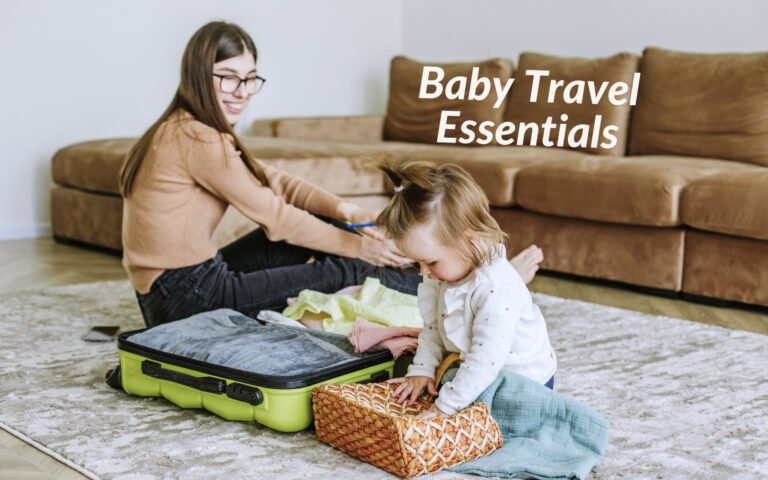
It’s also worth dressing your baby in bright, easy-to-spot colors for the trip and taking five minutes to walk the hallway and lobby layout yourself, so you know exactly where the stairwells, elevators, and exits are if you ever need to move quickly. For more first-trip logistics, our travel essentials guide covers what to pack beyond the safety basics.
Summary
You don’t need professional childproofing services to babyproof a hotel room — you need about fifteen minutes and a small kit you can reuse on every trip. Do the floor-level safety crawl first, then work outward: outlets and cords, furniture and TV stability, water access, sleep setup, and small parts like remote batteries. None of this requires special equipment beyond what fits in a gallon zip-top bag, and doing it the same way every time means it becomes second nature instead of a source of pre-trip stress.
Frequently Asked Questions
How long does it actually take to babyproof a hotel room?
Most parents can do a thorough sweep in ten to fifteen minutes once they have a routine: floor crawl, outlet covers, cord taping, TV push-back, and crib check. It gets faster with practice, and packing a dedicated kit in advance is what saves the most time.
Should I bring my own crib or use the hotel’s?
Either can work if the equipment meets current safety standards and is in good repair, with no broken or missing hardware and only the manufacturer’s original mattress. Call ahead to request a crib or portable playard, and inspect it yourself before use. If you’re not confident in the hotel’s equipment, a lightweight travel playard you bring yourself removes the guesswork.
Is it ever okay to bring my baby into bed with me on vacation?
Following consistent safe sleep guidance matters just as much on the road as it does at home, since travel doesn’t change how a soft hotel mattress, comforter, and pillows affect an infant’s airway. Keep your baby on a separate, firm sleep surface for every nap and every night of the trip, and talk with your pediatrician ahead of time if you have questions specific to your baby’s age or health.
What if the hotel room has a balcony?
Confirm the sliding or swinging door has a functioning childproof lock, and keep it locked whenever you’re not right there supervising. If you have flexibility when booking, choosing a room without a balcony removes the risk entirely.
Do I need to worry about hotel remote controls and key cards?
Yes — treat them like any other small-parts hazard. Remotes and some key card holders contain button or coin batteries that are dangerous if a baby manages to access and swallow them. Keep remotes on a high surface and check that battery compartments are securely closed during your initial room sweep.
This article is for general educational purposes and is not a substitute for personalized medical advice. Please consult your pediatrician with questions about your baby’s individual health, sleep, or feeding needs.