Flying With a Baby: A Calm, Practical Guide

15 mins read
Flying with a baby is safe for most healthy, full-term infants — the two things that matter most are how your baby is secured in the cabin and how you handle the pressure changes during takeoff and landing. Everything else is logistics, and logistics can be planned. I’m Ali Haider, and I’ve now done enough flights with a baby in tow to know that the day goes far better when you’ve decided the hard things in advance instead of at the gate.
What follows is the guide I wish someone had handed me before our first flight: what the American Academy of Pediatrics and the CDC actually say, what to pack, and where parents most often get caught out.
Key Takeaways
- Flying with a baby is generally safe for healthy, full-term infants after the first few weeks, according to Mayo Clinic — but babies born prematurely or with heart or lung conditions need clearance from a healthcare professional first.
- The safest place for your baby is in an FAA-approved child restraint in their own seat, not on your lap. The AAP has recommended this for decades.
- Turbulence is the leading cause of children’s injuries on airplanes, per the AAP — and it can happen with no warning.
- Feed or offer a pacifier during takeoff and the start of descent. Sucking and swallowing equalize middle-ear pressure; the CDC notes decongestants and antihistamines have not been shown to help.
- Never give a baby medication to induce sleep on a flight. Mayo Clinic warns it isn’t recommended and can backfire.
- Expressed milk, formula, ice packs and gel packs are exempt from TSA liquid limits under the Infant and Child Nourishment Exemption.
- Book a window or middle seat rather than the aisle, and gate-check the stroller — it usually doesn’t count against your baggage allowance.
Is Flying With a Baby Actually Safe?
For most babies, yes. Mayo Clinic states plainly that air travel is typically safe for most healthy, full-term infants after the first few weeks. The caveats are specific rather than vague, which I found reassuring.
Babies born before their due date may still need time for their lungs to mature, so Mayo advises checking with a healthcare professional before flying in a pressurized cabin. The same goes for any infant with heart or lung problems.
The reason has to do with cabin pressure. The CDC’s Yellow Book explains that commercial aircraft maintain a cabin pressure equivalent to a maximum altitude of about 8,000 feet, typically in the 6,000-to-8,000-foot range. Most people never notice. But an infant with a cardiopulmonary condition or sickle cell disease can be affected by the lower partial pressure of oxygen — which is exactly why that pre-flight conversation matters.
One more thing worth knowing: cabin air is dry, usually 10 to 20 percent humidity per the CDC. It won’t harm your baby, but it’s a good argument for feeding more often than you might on the ground.
When Can a Newborn Fly?
Cleveland Clinic notes that newborns can technically fly as early as seven days old, and that some airlines will ask for a note from your pediatrician if the baby is younger than that. But “allowed” and “advisable” are different questions.
Experts caution against flying in the first seven days after birth, and Mayo Clinic notes that some healthcare professionals suggest not traveling for the first few months at all. The reasoning isn’t about the flight itself — it’s that a newborn’s immune system is still learning, and an illness in a very young baby usually needs closer medical attention than it would in an older child.
If you have a choice about timing, later is easier. If you don’t — a family emergency, a move, a visa appointment — talk to your pediatrician, go, and be a bit more careful about hand hygiene and crowds.
The Seat Question: Lap Infant or Car Seat?
This is the single most consequential decision you’ll make, and it’s the one airlines make easiest to get wrong.
What the AAP actually recommends
The FAA does not require a ticket for children under two, which means an airline cannot stop you from holding your baby in flight. The AAP’s position is that this exemption is a mistake. In its policy statement on restraint use on aircraft, the Academy notes that preventable injuries and deaths have occurred in children younger than two who were unrestrained during survivable crashes and turbulence, and calls the current policy inconsistent with every other national standard for transporting children.
Think about it that way and the logic is hard to argue with. You would never drive your baby to the airport on your lap. The physics inside the cabin aren’t kinder.
The AAP’s parent guidance on flying with baby is blunt about why: studies show parents can’t reliably keep a firm grip on a child when the plane rocks or shudders, and turbulence is the leading cause of children’s injuries on airplanes. An AAP News review of in-flight medical events over a five-year period found that injuries disproportionately involved babies on laps and children in aisle seats.
How to spot an approved seat
Look for a label on the car seat stating: “This restraint is certified for use in motor vehicles and aircraft.” That exact wording is what the AAP tells parents to look for. A hard-backed car seat with that label, or an FAA-approved harness, is what you want — and it must also be right for your baby’s current age and size.
If you’re new to installing a seat on a plane, our guide to using a travel car seat on airplanes walks through the belt path and the window-seat rule, which most airlines enforce because a car seat in an aisle seat can block evacuation.
If buying a seat isn’t possible
I won’t pretend an extra fare is always affordable. If you’re flying as a lap infant, ask at the gate whether the flight is full — Mayo Clinic suggests asking about open seats when you board, since an unsold seat can sometimes be assigned to your infant at no charge. Bring the car seat to the gate either way. Worst case, you gate-check it.
Booking Choices That Make the Day Easier
Pick your seat deliberately
The AAP recommends a window seat where possible, and specifically flags aisle seats as risky for babies — passing carts and elbows are at exactly head height. A middle seat is the compromise if a window isn’t available.
Ask about bassinets on long-haul flights
On many wide-body aircraft, bulkhead rows have attachment points for an airline bassinet. They’re limited, weight-capped, and usually assigned first-come — so request one the moment you book, not at check-in. We covered what to expect from these in our post on plane bassinets, including the fact that you’ll typically be asked to lift your baby out during turbulence.
Think about timing honestly
Parents love the idea of a red-eye because “the baby will sleep.” Sometimes true. But an overtired baby in a bright, loud cabin at 2 a.m. is a rough combination, and so is arriving with no sleep yourself. I’ve had better luck flying during a long wake window and letting the flight overlap one nap rather than betting the whole trip on overnight sleep.
Getting Through the Airport
Security, milk, and formula
This is the part that surprises most first-time flying parents. The CDC confirms that in the United States, expressed milk and related infant feeding items are exempt from TSA limits on liquids and gels. The Infant and Child Nourishment Exemption covers expressed milk, ice, gel packs — frozen or unfrozen — and the accessories needed to transport milk.
You don’t have to travel with a baby to use the exemption, and you don’t have to keep quantities under the usual limit. Declare the items at the checkpoint, expect them to be screened separately, and build in ten extra minutes.
Strollers and gate checking
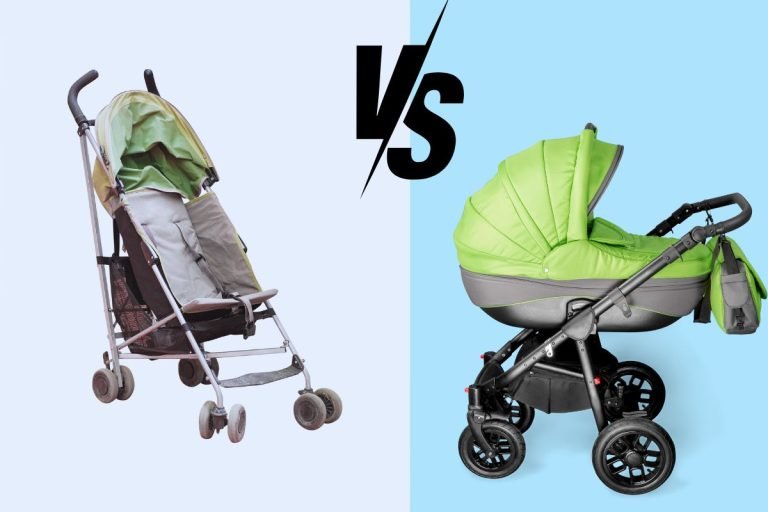
Car seats, boosters, and strollers generally aren’t counted as luggage, per the AAP. If you’re not using the car seat in flight, gate-checking it usually costs nothing and cuts the risk of damage compared with checking it at the counter. A padded travel bag helps. If you’re deciding which stroller to bring at all, our comparison of flying with a travel stroller covers cabin-size folds versus full-size gate checks.
Ears, Pressure, and the Crying You’re Worried About
Ear pain is the most common in-flight complaint for babies, and it’s usually worse on descent, not ascent. The CDC explains that middle-ear pressure equalizes through swallowing or chewing — which is why infants should nurse or suck on a bottle during those windows.
What actually helps
Offer the breast, a bottle, or a pacifier during takeoff and at the start of the landing process. Mayo Clinic suggests timing feeds so your baby is genuinely hungry at those moments, which makes them far more likely to suck steadily rather than fuss and refuse.
Cabin noise is loud too, especially at takeoff. Mayo notes that cotton balls, small earplugs, or noise-canceling headphones sized for infants may limit that exposure and make sleep easier.
What to skip
Two things. First, decongestants and antihistamines: the CDC states these have not been shown to be of benefit for flight ear pain, that antihistamines are contraindicated under age one, and that the AAP recommends against decongestants for any reason under age four.
Second — and I want to be emphatic here — do not give your baby medication to make them sleep. Mayo Clinic specifically warns against using diphenhydramine or similar products for this purpose, noting the practice isn’t recommended and the medicine can sometimes have the opposite effect. A wired, agitated baby at cruising altitude is a genuinely bad afternoon. Ask your pediatrician before giving your baby any medication before a flight.
What I Actually Pack in the Carry-On
Underpack the suitcase; overpack the diaper bag. Everything you truly need has to be within arm’s reach at 35,000 feet.
- Diapers: one per hour of total travel time, plus three. Airport delays are the reason for the plus-three.
- A full change of clothes for the baby, and a spare top for you. The blowout will happen on the flight where you skipped this.
- A wet bag for soiled clothes.
- More feeds than the flight length suggests — tarmac delays don’t care about your schedule.
- A muslin swaddle, which doubles as a sunshade, burp cloth, nursing cover, and clean surface.
- Pacifiers, plural, clipped so they don’t hit the floor.
- Hand sanitizer with at least 60 percent alcohol, the threshold the CDC uses for effective hand hygiene.
For a fuller checklist that covers checked luggage too, see our rundown of travel essentials for baby’s first trip.
Germs, Cabin Air, and Staying Well
Cabin air is better than its reputation. According to the CDC, recirculated cabin air passes through HEPA filters that capture 99.97 percent of particles at least 0.3 micrometers in diameter, and cabin air is refreshed 20 to 30 times per hour — a far higher exchange rate than most office buildings.
The real risk is proximity: the person coughing one row up, and the surfaces everyone touches. Wash or sanitize your hands often, wipe the tray table before it becomes a play surface, and try to keep the baby’s hands out of their mouth during boarding and deplaning, when the ventilation system may be off.
Mayo Clinic also makes a point I underrated on our first trip: caregiver health matters too. Flying with a child adds sleep loss and stress, and adults get sick from travel as well. Looking after yourself is part of looking after the baby.
Where Your Baby Sleeps on the Other End
The flight is the part everyone worries about, but the arrival is where safe-sleep rules get bent. A hotel crib, a borrowed travel cot, or a relative’s decades-old bassinet can all be a problem.
The AAP’s safe-sleep guidance does not relax because you’re on holiday. Your baby should sleep on their back for every sleep, on a firm, flat, non-inclined surface with a fitted sheet and nothing else — no pillows, blankets, bumpers, stuffed animals, positioners, or weighted products. Room-sharing without bed-sharing is recommended, ideally for at least the first six months. And a car seat is not a sleep surface once you’ve arrived: if your baby falls asleep in it, move them to a flat, safe space as soon as you reasonably can.
If you’re bringing your own portable cot, our guide to travel crib safety covers mattress rules, recall checks, and what to do when the hotel crib looks questionable.
When to Call Your Pediatrician Before You Fly
The CDC recommends making an appointment with your child’s primary healthcare professional or a travel medicine specialist at least one month before departure, particularly for international travel, and making sure your child is up to date on routine vaccines.
Call sooner rather than later if your baby was born prematurely, has a heart or lung condition, has had recent ear surgery or an ear infection, or is currently unwell. Cleveland Clinic specifically advises asking a healthcare professional when it’s safe to fly after ear surgery or an infection — flying with a blocked eustachian tube is where barotrauma becomes genuinely painful.
This article is general information from one parent to another, not medical advice. Your pediatrician knows your baby’s history and is the right person to make the call.
Summary
Flying with a baby comes down to a handful of decisions made early. Get your baby cleared to fly if there’s any reason for doubt. Secure them in an FAA-approved restraint in their own seat if you possibly can, and choose a window or middle seat if you can’t. Feed on takeoff and descent. Skip the decongestants and never medicate for sleep. Pack the diaper bag for a delay, not for the flight. And keep safe sleep intact at the other end.
The cabin is a strange place to parent, but it’s only a few hours. Most of the flights I dreaded turned out fine — and the ones that didn’t were survivable, which is a lower bar than it sounds and a genuinely useful one.
If your trip involves driving on either end, our guide to a road trip with a baby covers the car-seat and break-schedule side of the journey.
Frequently Asked Questions
How old does a baby have to be to fly?
Most airlines will accept an infant from about seven days old, and some will ask for a pediatrician’s note below that age. Cleveland Clinic notes that experts caution against flying in the first week after birth, and Mayo Clinic reports that some healthcare professionals suggest waiting a few months. There is no single right answer — it depends on your baby’s health and how much choice you have about timing.
Do I have to buy a seat for my baby?
No. The FAA does not require a ticket for children under two, which is why lap infants are permitted. However, the American Academy of Pediatrics recommends that every child, including infants, be secured in an approved child restraint, and it has asked for a federal requirement to that effect. Buying a seat is the safer choice where your budget allows.
What can I do about my baby’s ears on a plane?
Offer the breast, a bottle, or a pacifier during takeoff and at the beginning of descent. Swallowing equalizes middle-ear pressure. The CDC notes that antihistamines and decongestants have not been shown to help, and both carry age restrictions for young children.
Can I bring breast milk and formula through airport security?
Yes. In the United States, expressed milk, formula, ice, and gel packs are exempt from the usual TSA limits on liquids under the Infant and Child Nourishment Exemption. Declare them at the checkpoint and allow extra time for separate screening.
Is it safe to give my baby something to help them sleep on a flight?
No. Mayo Clinic advises against giving a baby medication such as diphenhydramine to induce sleep on a plane, noting the practice isn’t recommended and can sometimes have the opposite effect. Do not give your baby any medication before a flight without asking your pediatrician first.
Should I gate-check the stroller or the car seat?
Either can usually be gate-checked at no cost, and strollers and car seats generally don’t count toward your baggage allowance. Gate-checking reduces handling compared with checking at the counter. If you’ve bought a seat for your baby, bring the car seat on board instead and check only the stroller.
Is cabin air bad for a baby?
The air itself is well filtered — the CDC reports that HEPA filters capture 99.97 percent of particles 0.3 micrometers and larger, with 20 to 30 air changes per hour. The bigger factors are close proximity to other passengers and shared surfaces, so hand hygiene and wiping down the tray table matter more than the air supply does.


2 Comments