International Travel With a Baby: A Practical Guide

12 mins read
International travel with a baby is absolutely doable — it just needs a different kind of planning than the trips you took before. The short answer: book a pre-travel medical visit about six weeks out, sort your baby’s passport early, build your packing list around feeding and safe sleep rather than entertainment, and accept that the trip will run on your baby’s clock, not the itinerary’s.
I took my daughter on her first long-haul flight when she was seven months old, and the thing that surprised me most was how much of the stress was front-loaded. The paperwork, the pediatrician appointment, the water-safety questions — that was the hard part. The actual traveling, once we’d done the homework, was calmer than I expected.
Key Takeaways
- Start early. The CDC advises travelers who are unsure of their measles protection to see a clinician at least six weeks before departure, which is a sensible planning anchor for international travel with a baby generally.
- Passports have no minimum age. Every U.S. citizen, newborns included, needs their own passport book for international air travel, and children’s passports must be applied for in person.
- Ask about early MMR. The CDC recommends one dose of MMR vaccine for infants aged 6–11 months traveling internationally, given at least two weeks before the trip.
- Feeding is a safety issue abroad. The CDC notes that breastfeeding is the best way to reduce an infant’s risk of food-borne and waterborne illness.
- Plan for sleep, not just flights. Bring a safe sleep surface and follow current AAP safe-sleep guidance in every hotel, rental and relative’s spare room.
- Talk to your pediatrician before booking anything health-sensitive — destination, timing, vaccines and repellents are all decisions that belong with your child’s own doctor.
When Is a Baby Old Enough to Travel Internationally?
There is no single magic age, and honestly, the answer depends more on your baby’s health history than on a number. Healthy newborns are physiologically fit to fly, according to the American Academy of Pediatrics’ guidance on flying with a baby, provided parents take sensible precautions.
That said, the practical picture shifts around six months. Infants younger than six months cannot receive the measles vaccine — the CDC does not recommend it below that age — which leaves them relying on everyone around them for protection. If your destination has active measles transmission, that matters.
Premature babies, babies with chronic lung or heart conditions, and babies recently discharged from a neonatal unit are a separate conversation entirely. For those families, the timing question is a medical one, and your pediatrician should be the one answering it.
What About the Return Trip?
One thing I wish I’d thought about sooner: the journey home is usually harder than the journey out. You’re tired, your baby’s routine has already been disrupted once, and you’re crossing time zones in the direction that suits nobody. Build a genuinely empty day into your calendar after you land.
Passports and Paperwork for a Baby
Your baby needs their own passport. There is no minimum age and no shared-with-parent option for U.S. passports, so a two-week-old flying abroad needs a passport book just as an adult does. Applications for children under sixteen must be submitted in person, and both parents or legal guardians generally need to be involved — either present together, or with notarized consent from the absent parent.
The photo is the part that defeats most people. The baby must be alone in the frame with eyes open if possible, no hands supporting the head, and no pacifier. A white sheet on the floor with the baby laid on their back works better than any studio attempt I made.
The U.S. State Department is the definitive source for current processing times, fees and the exact form requirements, and those change often enough that it is worth checking directly rather than trusting a blog — including this one. Build in far more lead time than you think you need. If your destination requires a visa, that is a second queue on top of the first.
The Pre-Travel Health Visit
This is the single highest-value hour of the whole planning process. Book it early and bring your itinerary, because the advice genuinely changes by destination.
Vaccines are the headline item. The CDC recommends that infants aged 6–11 months traveling internationally receive one dose of MMR at least two weeks before departure — and that dose does not count toward the routine schedule, so the baby still needs doses at 12–15 months and again at 4–6 years. Two doses of MMR provide about 97% protection against measles, which is why CDC travel guidance on measles puts so much weight on being current before you fly.
Other destination-specific vaccines may or may not be options depending on your baby’s age. The CDC Yellow Book chapter on travel vaccines for infants and children lays out which vaccines have pediatric age floors, and there are more of them than most parents expect.
Malaria deserves its own paragraph. The CDC reports that children under five account for roughly 80% of malaria deaths worldwide, and in U.S. cases, pediatric patients presented with severe disease far more often than adults — around 32% versus 10%. If your destination has malaria transmission, prophylaxis and bite prevention are not optional extras, and the specific drug and dose must come from your pediatrician.
Ask your doctor, too, about what to do if your baby gets sick abroad: which symptoms mean “find a clinic today”, what travel insurance actually covers, and whether there is a reputable pediatric facility near where you’re staying.
Feeding Your Baby Safely Abroad
Food and water are where international travel with a baby differs most sharply from domestic travel. The CDC notes that travelers’ diarrhea is the most predictable travel-related illness, with attack rates of 30%–70% over a two-week period depending on destination and season — and that bacterial pathogens cause more than 80% of cases.
Babies dehydrate faster than adults, which is what turns an inconvenience for you into an emergency for them. The CDC’s travelers’ diarrhea chapter is worth reading before you go, and oral rehydration salts are worth packing.
If You’re Breastfeeding
Keep going if you can. The CDC states plainly that breastfeeding is the best way to reduce an infant’s risk of food-borne and waterborne illness, and it removes the water-quality problem from your trip entirely. Travel is dehydrating for you too, so drink more than feels necessary.
If You’re Formula Feeding
Two things change abroad. First, formula sold overseas may not have the same nutritional composition or manufacturing standards as the product you use at home, so bringing your own supply is the safer default. Second, water preparation matters more.
For infants under three months and those with weakened immune systems, the CDC advises reconstituting powdered formula with hot water at or above 70°C (158°F) — boil the water, wait roughly five minutes, then mix, and let the formula cool before feeding. CDC food and water precautions cover the broader rules on bottled water, ice and washing bottles.
Our post on traveling with baby formula and breast milk goes deeper on the airport-security side of this, which is a separate headache from the water-safety side.
Starting Solids on the Road
If your baby has started solids, a trip abroad is not the moment to introduce a brand-new allergenic food for the first time. Stick to foods you already know they tolerate, and apply the same food-safety rules you’d apply to yourself, only stricter.
Flights, Ears and the Long Haul
Pressure changes during takeoff and descent are the most common in-flight complaint. The AAP’s advice is simple and it works: have your baby feed from the breast or a bottle, or suck on a pacifier during takeoff and landing.
If your baby has had an ear infection or ear surgery in the two weeks before the trip, ask their doctor whether flying is fine. Most children with ear infections travel safely by air, but that clearance should come from someone who knows your baby.
The safest place for a baby on a plane is in an approved child restraint on their own purchased seat, not on your lap — the same physics that makes car seats non-negotiable in a car applies at 35,000 feet. We’ve covered the practical side of this in our guide to flying with a baby.
Sleep, Sun and Bites at the Destination
Safe sleep does not get a holiday. Wherever you land, your baby needs their own firm, flat, non-inclined sleep surface — a travel crib, a hotel cot you’ve inspected, or a portable play yard that meets current safety standards. Bare surface: no pillows, no bumpers, no loose blankets, no positioners. Back sleeping every single time, and room-sharing without bed-sharing.
Hotel rooms and vacation rentals tempt tired parents into shortcuts here, and that is exactly when accidents happen. CDC guidance for traveling with children reinforces the point that the sleep environment should not change just because the zip code did.
Sun protection is the other destination-specific risk. The CDC notes that sun exposure — and sunburn before age fifteen in particular — is strongly associated with melanoma and other skin cancers. For babies under six months, shade, hats and lightweight long sleeves do the work; sunscreen products carry a label instructing parents of under-sixes to ask a doctor. From six months, the AAP recommends a broad-spectrum sunscreen of at least SPF 15, and mineral formulas with zinc oxide or titanium dioxide are usually the better choice for baby skin, per AAP sunburn prevention guidance.
Insect repellent has its own age rules. The AAP advises extra caution with DEET and similar chemicals on newborns and premature infants, and says products containing oil of lemon eucalyptus or para-menthane-diol should not be used on children under three. The AAP’s insect repellent guidance is the place to check before you buy, and a mosquito net over the stroller and cot does a lot of work without any chemistry at all.
Time Zones
Crossing several time zones will scramble your baby’s schedule for a few days, and pretending otherwise just makes everyone miserable. Daylight exposure at the right times is your main tool. Our guide to baby jet lag and resetting sleep after time zones walks through how we handled it.
Packing for International Travel With a Baby: What I Would Change
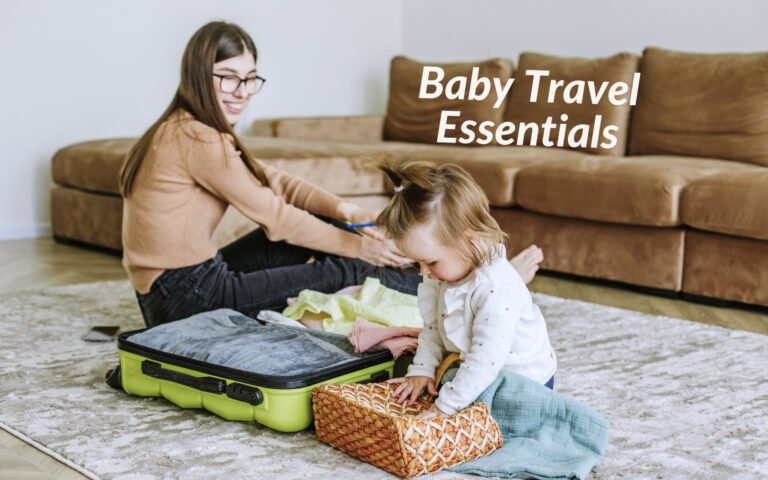
Less clothing, more medicine. I packed outfits for a baby who was going to be photographed constantly and then spent the week doing laundry anyway. What I ran short of was the boring stuff: oral rehydration salts, a digital thermometer, saline drops, a spare pacifier, and enough diapers for a full day of delays.
The CDC Yellow Book chapter on traveling safely with infants and children has a thorough kit list, and it is more useful than any packing post you’ll find — including, again, this one.
The other thing I’d change is ambition. We tried to see three cities. One would have been plenty.
Summary
International travel with a baby rewards early, unglamorous preparation. Apply for the passport sooner than feels necessary, book a pre-travel medical visit around six weeks out, and let your pediatrician shape the destination and vaccine decisions. Abroad, treat feeding and water safety as the primary health risk, keep the safe-sleep rules identical to the ones you follow at home, and protect against sun and insects using age-appropriate products. Then lower your expectations for the itinerary — the trip works best when the baby sets the pace.
This article is general information, not medical advice. Please talk to your own pediatrician about your baby’s health, vaccines, destination risks and fitness to travel before you book.
Frequently Asked Questions
Does my baby need a passport for international travel?
Yes. There is no minimum age for a U.S. passport, and babies cannot travel on a parent’s passport. Applications for children under sixteen must be made in person, and both parents or legal guardians are normally required to consent. Check the U.S. State Department for current processing times, because they vary considerably through the year.
What is the best age for international travel with a baby?
There is no universally best age, and it depends on your baby’s health rather than a calendar. The AAP notes that healthy newborns are physiologically fit to fly. Practically, many parents find the window before crawling easier than the toddler stage, though measles vaccination is not an option below six months. Your pediatrician is the right person to weigh your specific situation.
Can my baby get the measles vaccine early for a trip abroad?
The CDC recommends one dose of MMR for infants aged 6–11 months traveling internationally, given at least two weeks before departure. That early dose does not replace the routine schedule, so a further dose is still needed at 12–15 months and again at 4–6 years. Ask your pediatrician whether this applies to your trip.
How do I prepare formula safely in another country?
Bring your own formula where possible, since products abroad may differ in composition and manufacturing standards. For infants under three months, the CDC advises mixing powdered formula with water at or above 70°C (158°F) — boil it, wait about five minutes, mix, then let it cool before feeding. Use bottled or boiled water for rinsing bottles where tap water is not safe to drink.
What should I do about safe sleep in a hotel or rental?
Recreate your home setup. Your baby needs their own firm, flat, non-inclined surface with nothing in it — no pillows, bumpers, blankets or positioners — placed on their back to sleep, in your room but not in your bed. Inspect any provided cot yourself, and bring a travel crib if you have any doubt about what will be waiting for you.
Is travelers’ diarrhea dangerous for babies?
It needs to be taken seriously, because infants dehydrate much faster than adults. The CDC puts attack rates at 30%–70% of travelers over two weeks depending on the destination. Pack oral rehydration salts, follow food and water precautions strictly, and ask your pediatrician in advance which symptoms should send you to a clinic rather than waiting it out.